How Spin Mops Work: The Physics Behind the "Zero-Gravity" Clean

When you mop manually, you are relying on "elbow grease." Physics calls this Static Friction. You have to push down (weight) and drag (force) to dislodge dirt. It’s inefficient. A human arm can typically scrub at about 60 strokes per minute, applying uneven pressure.

Man vs. Machine
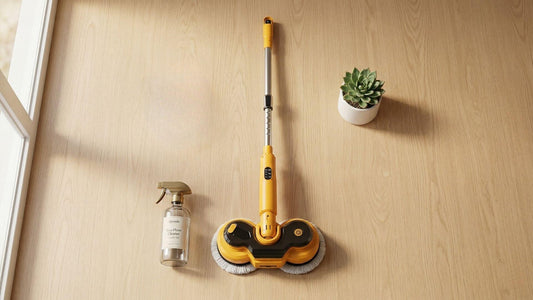
The Qimedo M2 Electric Spin Mop replaces muscle with mechanics. It uses Kinetic Friction generated by high-velocity rotation. But how does it clean better while feeling weightless? The secret lies in the Counter-Rotating Dual Motors.
The Secret Sauce: Counter-Rotating Heads
If both mop heads spun in the same direction (e.g., clockwise), the mop would pull violently to the right. You’d have to fight it to keep it straight.
The Qimedo M2 uses Counter-Rotation:
- Left Head: Spins Counter-Clockwise.
- Right Head: Spins Clockwise.
The "Hover" Effect (Self-Propulsion) Because the forces cancel each other out horizontally, the energy is directed inward. This creates a balanced "Hover Effect." The rapid rotation reduces friction between the machine and the floor to near zero.
- The mop feels like it’s floating. It creates its own forward momentum (Self-Propulsion). You don't push the mop; you simply guide it.

The Power of 800 RPM (Rotations Per Minute)
Standard electric mops spin at 150 RPM. The Qimedo M2 hits 800 RPM. Why does speed matter?
The Math of Cleaning:
- Manual Scrubbing: ~60 scrubs/min.
- Standard Mop: 150 RPM x 2 heads = 300 scrubs/min.
- Qimedo M2 (Gear 3): 800 RPM x 2 heads = 1,600 scrubs/min.
In just one minute, the M2 does nearly 30 minutes worth of manual scrubbing. The high speed generates heat and friction that liquefies grease and lifts dried stains instantly—no chemicals required. This transforms it from a mop into a true floor buffer polisher.

Torque vs. Speed: Why It Doesn't Stall
A common problem with cheap floor scrubber machines is that they spin fast but stop as soon as they touch the floor (Low Torque). The Qimedo M2 is engineered with a High-Torque Motor (210W). It maintains its 800 RPM speed even when applied to high-friction surfaces like carpets or textured tile grout. It digs in, it doesn't give up.
The Microfiber Physics
It’s not just the motor; it’s the pads. The M2 uses high-density microfiber pads.
- Microfiber strands are split at a microscopic level, creating tiny hooks.
- At 800 RPM, these hooks act like thousands of tiny fingers grabbing dust particles and holding them tight via static electricity. This is why it leaves floors streak-free—it captures dirt rather than spreading it.
Conclusion: Cleaning is Science
Stop relying on your biceps. Let physics do the work. Experience the Zero-Gravity feel of the Qimedo M2.
Tags:
Previous
Stop Scrubbing on Your Knees: The Best Tile Floor Scrubber for Grout Lines
Next
Get Commercial Floor Scrubber Results at Home with the Qimedo M2